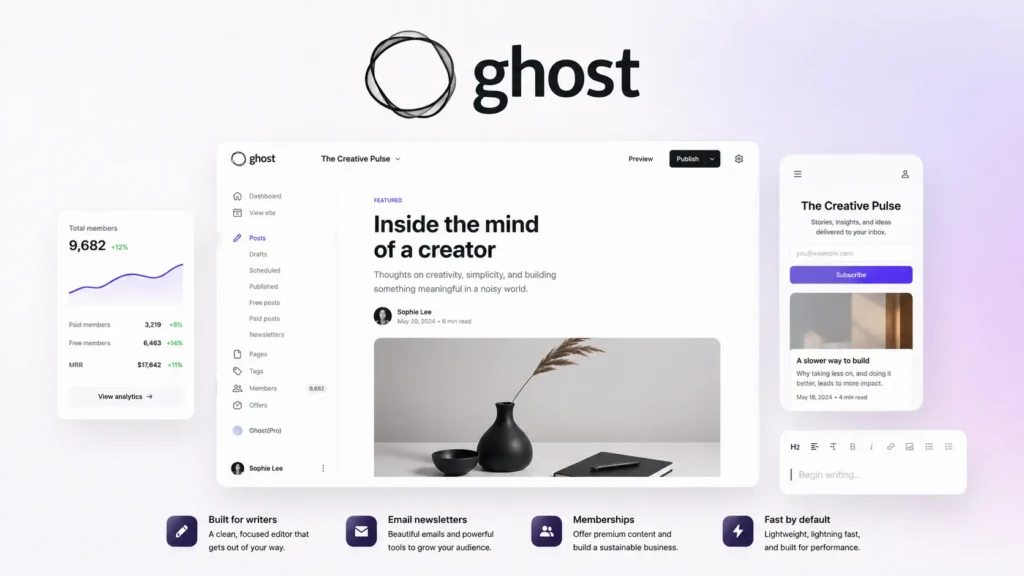
Ghost is a website platform built mainly for publishing. That means blogs, newsletters, memberships, subscriptions, and content-driven websites. It is not trying to be everything. It is not trying to be WordPress with a million plugins. It is not trying to be Shopify. It is not trying to be Wix.
Out of the box, Ghost gives you a clean publishing system where you can write posts, send newsletters, collect members, offer paid subscriptions, and build a content business around your website. That focus is the important part. A lot of website platforms try to do everything. Ghost does not. Ghost is best when your website is built around content.
What Ghost Actually Does
At its core, Ghost is a content management system, or CMS. That means it gives you a backend where you can create, edit, organize, and publish content on your website. But Ghost is not just a basic blogging tool anymore.
You can use Ghost to create blog posts, send email newsletters, build a free or paid membership site, publish members-only content, collect subscribers, run a publication-style website, use themes to control the design, and connect your site with other tools and services.
From a technical standpoint, Ghost is a leaner publishing platform compared to something like WordPress. WordPress can become almost anything because of plugins. Ghost is more controlled. That can be good or bad depending on what you need. If you want a simple publishing setup that feels clean and focused, Ghost makes a lot of sense. If you want a fully custom business website with advanced forms, directories, courses, booking systems, WooCommerce, custom Elementor layouts, and a bunch of integrations, I’d honestly lean toward WordPress.
Ghost vs WordPress
This is usually where people get stuck. Ghost and WordPress can both run a blog. They can both publish content. They can both be used for a website. But they are not really built for the same type of person.
WordPress is more flexible. You can build almost anything with it, especially when you add tools like Elementor, WooCommerce, custom post types, form plugins, SEO plugins, caching plugins, and all the other fun little things that eventually make you question your life choices. Ghost is more focused. It is better for publishing, newsletters, memberships, and clean content delivery.
The tradeoff is simple. With WordPress, you get more control, but you also manage more moving parts. With Ghost, you get a cleaner publishing workflow, but you give up some flexibility. That does not mean one is better for everyone. It depends on the job.
Who Ghost Is Good For
Ghost makes the most sense for writers, publishers, newsletter creators, bloggers, independent media brands, and people who want to build an audience around content. If your main goal is to publish articles, grow an email list, and maybe charge for premium content, Ghost is worth looking at.
Ghost has built-in membership features, which means you do not have to duct tape together five different plugins just to start a basic content membership model. And quite honestly, that is one of Ghost’s biggest strengths. The less you have to glue together, the fewer things you have to fix later.
Where Ghost Falls Short
Here’s the issue. Ghost is not the platform I would pick for every website.
If you need a business website with a lot of custom pages, landing pages, service pages, design flexibility, funnels, product layouts, client portals, advanced search, complex forms, or eCommerce, Ghost can start to feel limiting. Yes, you can customize Ghost. Yes, developers can do a lot with it. But for the average small business owner or freelancer, WordPress is usually easier to extend because the ecosystem is bigger.
With WordPress, there is probably a plugin for whatever weird thing you need. With Ghost, the answer is more often custom development, integrations, or adjusting your expectations. That is not necessarily bad. It just means Ghost is not trying to be the everything platform.
Is Ghost Better Than WordPress?
Not across the board. Ghost is better if your website is mainly a publication. WordPress is better if your website needs to be a full business system.
That is probably the cleanest way to think about it. If I were building a content-first newsletter brand, paid publication, or independent blog where writing is the product, Ghost would be high on my list. If I were building a service business website, affiliate site with custom layouts, local business site, WooCommerce store, or a site that needed Elementor-level design control, I’d stick with WordPress.
Ghost is clean, fast, and focused. WordPress is flexible, powerful, and messy if you do not manage it properly. Pick your tradeoff.
Should You Use Ghost for Your Website?
If your website is mostly about publishing content and growing an audience, Ghost is a very good option. It gives you a cleaner setup than WordPress in some cases, especially if you want blogging, newsletters, and memberships built into one system.
But if your website needs heavy customization, lots of plugins, advanced design control, or business-specific features, WordPress is probably the better choice. From my perspective, Ghost is not a WordPress replacement for everyone. It is a better fit for a specific type of website.
Use Ghost when the content is the business. Use WordPress when the website needs to do more than publish.
Ghost is not bad. WordPress is not automatically better. They are just built around different priorities. For a clean publishing setup, Ghost makes a lot of sense. For a flexible website system, I’d still lean WordPress.